
Munitions-contaminated land: the number everyone quotes
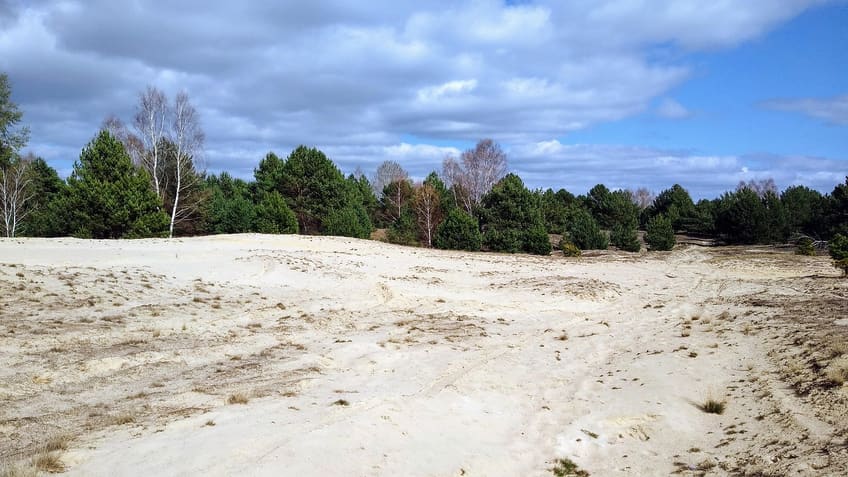
On the evening of 31 May 2023 a fire started on the former military training area (Truppenübungsplatz) near Jüterbog. Within a few hours it grew from four to about 13 hectares. On 14 June, when it was reported out, it covered 688 hectares.
No wrong decision was made in between. There is ordnance in the ground, and where there is ordnance, crews keep their distance instead of putting the fire out. They did what the rules provide for.
What exactly the rules provide for is harder to find out than it should be. Anyone who looks it up finds three numbers: 300 metres, 500 metres, 1,000 metres. The source given is almost always FwDV 500.
In Brandenburg, around 575,000 hectares are classed as suspected of containing unexploded ordnance (kampfmittelverdächtig), about a fifth of the state's area, of which around 300,000 hectares are forest. The state's ten largest forest fires since 2002 were all on ground of that kind.
What FwDV 500 actually says
FwDV 500 is the fire service directive for CBRN incidents (ABC-Gefahren); there is no fire service directive for unexploded ordnance (Kampfmittel). The federal states' guidance documents (Handlungsempfehlungen) therefore fall back on FwDV 500 for unexploded ordnance.
Its basic values are a danger zone (Gefahrenbereich) of about 50 metres and a cordon (Absperrbereich) of about 100 metres. Where there is a risk of explosion or of a container bursting (Zerknallgefahr), the danger zone has to be extended considerably.
For larger quantities of explosives or military munitions exposed to fire, the AFKzV's explanatory notes give at least 300 metres with adequate cover, plus a cordon of 1,000 metres. The Hessian guidance on forest and vegetation fires in munitions-contaminated areas gives the same values.
When the 300 metres are quoted, two parts of the sentence regularly get lost. The first is the condition with adequate cover (bei ausreichender Deckung), to which the 300 metres are tied. The second is that the distance can be adjusted after further reconnaissance and assessment of the hazards. What gets quoted is a fixed limit. What the original describes is a decision for the incident command, based on what is known about the ground.
The 500 metres are not in FwDV 500 in that form. The May 2026 working-group version from the training and tactics sub-group (UAG Ausbildung und Taktik) of the federal-state working group on national wildfire protection (BLoAG Nationaler Waldbrandschutz) gives 500 metres with adequate cover, next to a value of 1,000 metres according to the DGUV, the German statutory accident insurance. The literature is not consistent on this point. Anyone who puts one of these numbers in a memo should say which source it comes from.
Contaminated or suspected
What decides the tactics is not the number but the kind of ground. The Hessian guidance separates two cases.
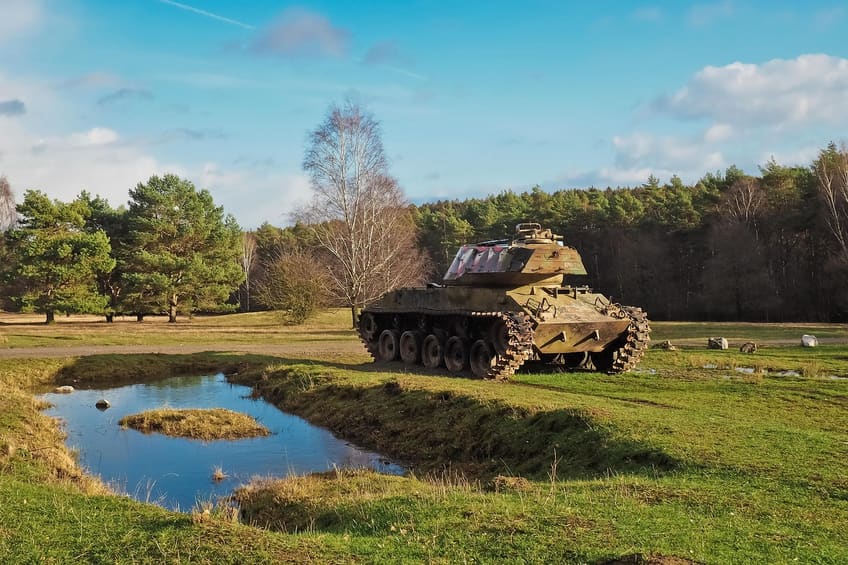
On ground with confirmed munitions contamination (sicher munitionsbelastet), firefighting is defensive. Entering ground with confirmed contamination is not permitted as a matter of principle. The fire is held at control lines (Riegel), tracks and ground clear of vegetation.
On ground where contamination is unknown or suspected, offensive firefighting is possible, provided crews have been briefed on warning signs such as explosions or sudden jets of flame. If such signs appear, crews withdraw.
The 575,000 hectares in Brandenburg are suspected, not confirmed. Most of Brandenburg's suspect ground therefore falls under the rules for suspected contamination. Anyone who lumps the two together describes the situation as stricter than it is.
What is done today
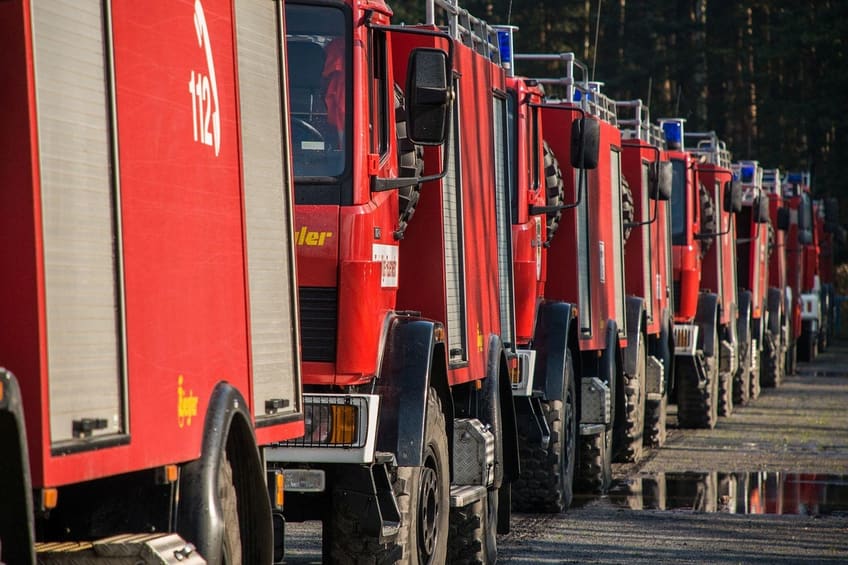
According to the Hessian guidance, on ground with confirmed contamination the fire is held at firebreaks (Feuerschneisen, Wundstreifen) and at existing fire-proof barriers such as roads and tracks. Unmanned monitors can be set up at those barriers. Holding lines towards villages (Sperrriegel) are fixed and kept clear in advance.
On munitions-contaminated ground, firefighting from the air is often the only offensive option, according to the same guidance, although aircraft also have to keep safety distances from the ground. The May 2026 UAG version considers direct use of aircraft there generally not effective because of those distances. On the ground, according to the UAG version, remotely operated systems have proved themselves on contaminated ground for clearance and firefighting.
The ordnance advisers of the explosive ordnance disposal service (Kampfmittelräumdienst) have to be involved, and on their assessment the incident command can adjust the danger zone. The UAG version recommends requesting the disposal service as soon as a fire on suspect ground is confirmed, and involving the forest fire protection officer (Waldbrandschutzbeauftragter) as an adviser.
On ground with confirmed contamination, the interior therefore burns out between the barriers.
Drones do reconnaissance over this ground. The UAG version names them for monitoring unmanned holding positions on munitions-contaminated ground.
Unmanned systems over this ground
For suppression, they are being tested internationally. Since October 2025, Korean Air and Anduril Industries have been exploring the joint development of an AI-supported platform, in which the software is to handle detection and command and suppression is to be carried out by rapidly available unmanned aircraft or by crewed air tankers.
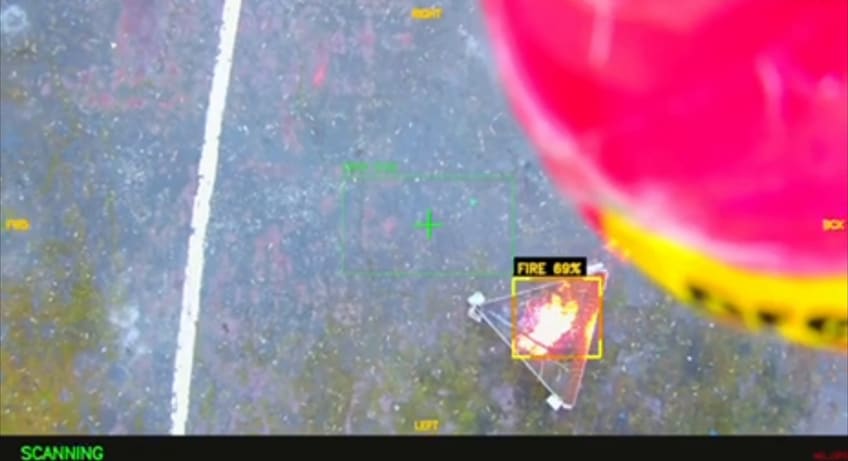
The hard part is not the drop. On munitions-contaminated ground nothing can be surveyed beforehand and nothing can be recovered afterwards. Whatever flies there works without a secured view of the ground and without being able to rely on satellite navigation, and whatever is dropped there has to be allowed to stay where it lands.
What to settle before a deployment
Five points need to be settled, whichever supplier is involved.
The operating category. In the open category, dropping objects is not permitted, and neither is carrying dangerous goods. Flight and reconnaissance in A3 are not affected by this. Anything that releases something is.
The exemption for public safety authorities (BOS). § 21k LuftVO exempts the operation of drones with a take-off mass under 25 kilograms, by or under the supervision of authorities and organisations with safety tasks, from the authorisation requirement under Article 12 of Implementing Regulation (EU) 2019/947. According to EGRED 2, this also covers a third party flying under the supervision of a BOS (unter Aufsicht). For an authority this is the most useful point on the list, because it describes exactly the arrangement in which a company works for it. The national minimum standards for this are set out in EGRED 2 and in the STS-BOS of the Luftfahrt-Bundesamt, the federal aviation office.
The airspace. Police helicopters and air tankers work over a fire. The recommendation from the DFV and the AGBF requires coordination and recommends visibility via ADS-B or FLARM. For an incident command, this objection comes first.
The extinguishing agent. Whether it may be placed on the market in Germany and the EU is a question of product law and of the state's market surveillance. Whether a permit under § 7 SprengG is needed, and how storage and transport are regulated, is a second question. Both are rarely asked, and both apply to every supplier of a system that drops something, including us.
The failed drop. What happens to a payload that does not go off, on ground nobody is allowed to enter. There should be an answer to that before anything flies.
| What to settle | Basis |
|---|---|
| Operating category: dropping objects and dangerous goods are not permitted in the open category | Regulation (EU) 2019/947 |
| Exemption for the BOS: drones under 25 kg, including third parties flying under the supervision of a BOS | § 21k LuftVO, EGRED 2 (BBK, as of June 2024), STS-BOS (LBA, 16 July 2025) |
| Coordination with crewed aviation, visibility via ADS-B or FLARM | DFV and AGBF, Fachempfehlung Drohnen und UAV, August 2025 |
| Extinguishing agent: placing on the market, market surveillance, permit, storage, transport | ProdSG, § 7 SprengG, 1. SprengV |
| Failed drop: what happens to a payload that has not gone off, on ground nobody may enter | Deployment planning |
The checklist as a PDF
The table is available as a PDF to print and pass on. No form, no registration, no email address needed.
Questions about a specific area or a planned trial: info@averiumdynamics.com, or directly to Leo Safia at leo@averiumdynamics.com.
Sources
- Feuerwehr Jüterbog, via dpa on t-online, 1 June 2023. The fire broke out on the evening of Wednesday 31 May on the former military training area, and grew from four to about 13 hectares within a few hours. t-online.de
- Stiftung Naturlandschaften Brandenburg, 15 June 2023. The all-clear on 14 June. wildnisstiftung.de
- Brandenburg Ministry of Agriculture, Environment and Climate Protection (MLUK), forest fire figures for 2023, via dpa in the Nordkurier, 2 November 2023. The 688 hectares affected. nordkurier.de
- FwDV 500, Einheiten im ABC-Einsatz. AFKzV. The basic values for the danger zone and the cordon. feuerwehr.bremen.de
- AFKzV, Erläuterungen zur FwDV 500, as of 2004. IdF Nordrhein-Westfalen. The 300 metres with adequate cover and the 1,000-metre cordon. idf.nrw.de
- Handlungsempfehlung Wald- und Flächenbrände in munitionsbelasteten Gebieten, as of 26 August 2019. Feuerwehr Hessen. The distinction between confirmed and suspected ground, the defensive tactics at firebreaks, roads and tracks, unmanned monitors, holding lines, firefighting from the air, and the ordnance disposal advisers. feuerwehr.hessen.de
- UAG Ausbildung und Taktik der BLoAG Nationaler Waldbrandschutz, May 2026 version. DFV. The 500 metres and the DGUV value, the assessment of aircraft, remotely operated systems, the ordnance disposal service, forest fire protection officers, and drones for monitoring. feuerwehrverband.de
- Fachagentur Nachwachsende Rohstoffe, Themendossier Waldbrand. The area figures for Brandenburg and the ten largest forest fires since 2002. wald.fnr.de
- § 21k LuftVO as currently in force, accessed 12 November 2026. Operation by or under the supervision of the BOS, drones with a take-off mass under 25 kilograms. gesetze-im-internet.de
- Bundesamt für Bevölkerungsschutz und Katastrophenhilfe, EGRED 2, version 2, as of June 2024. Section 3.1.1: the § 21k LuftVO exemption, including operation by third parties under the supervision of the BOS, and the minimum standards for BOS drone operations. bbk.bund.de
- Luftfahrt-Bundesamt, STS-BOS, 16 July 2025. The standard scenarios for the BOS that supplement EGRED 2. lba.de
- DFV and AGBF, Fachempfehlung Drohnen und UAV in den Feuerwehren, August 2025. Airspace coordination and visibility. feuerwehrverband.de
- Korean Air and Anduril Industries, joint announcement of 2 October 2025, as reported by UAS Weekly. The joint exploration of the platform. uasweekly.com
Disclosure: Averium Dynamics develops firefighting drones. The five points above apply to us as they do to any other supplier.
Photographs from Pixabay, used under the Pixabay Content Licence: winklerchristopher, rico_loeb and distelapparath.
Supported by